


Version 1.0
Released on April 28, 2025
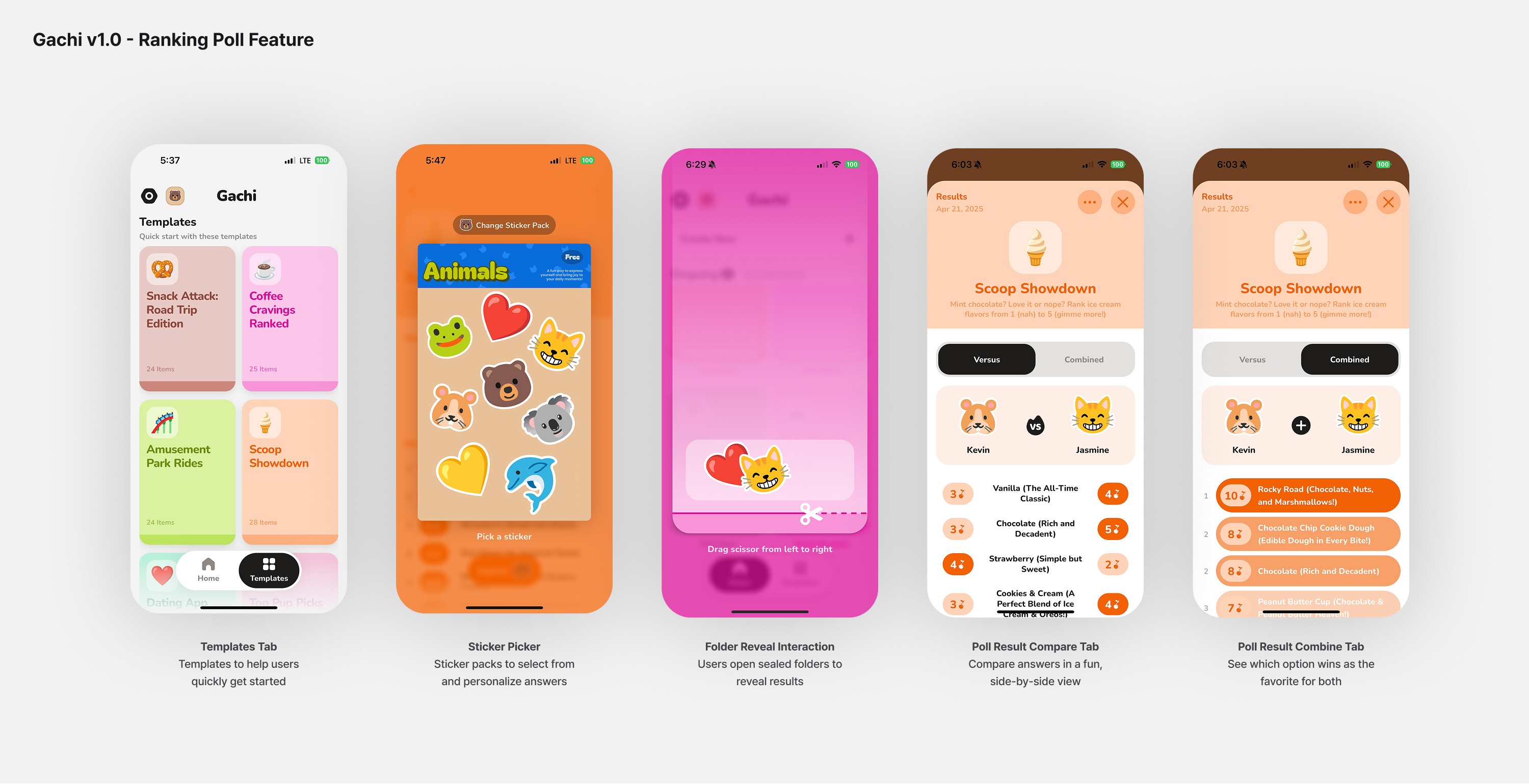
My initial idea was broader: a lighthearted communication app for couples using polls and questions.
Key Learnings
Low retention
Early user tests showed they were fun at first but not engaging long term. Retention dropped quickly once the novelty wore off.Content is hard to scale
Managing poll content across three languages (English, Korean, Japanese) quickly became unsustainable as a solo developer.Backend complexity
Even a simple couple app required a robust synced database. I had to learn Firebase from scratch and design for scalability, security, and cost efficiency. Getting the app stable enough to release was already a major milestone.
Version 2.0
Released on August 26, 2025
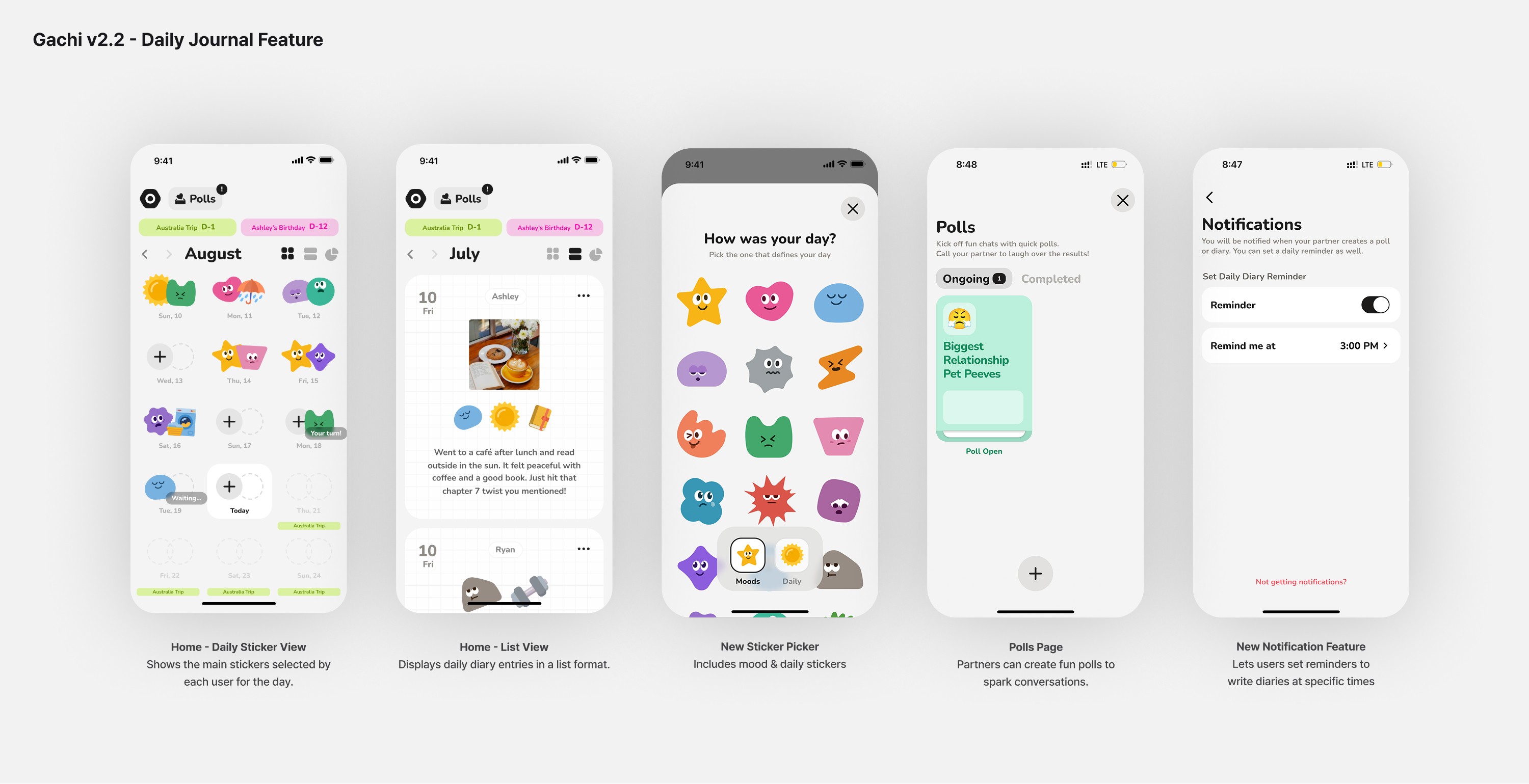
Following the first release, it became clear that targeting all couples with polls and questions was too broad, and the space was already saturated with competitors like Paired, Agape, and Candle. To differentiate, I repositioned Gachi for long-distance couples—a focused audience with distinct needs and a large, engaged community (e.g. 220K weekly visitors on Reddit’s r/LongDistance, 300K+ targetable via Meta Ads). This direction also felt personal, as I am in a long-distance relationship myself.
Shared Journal as Core Feature
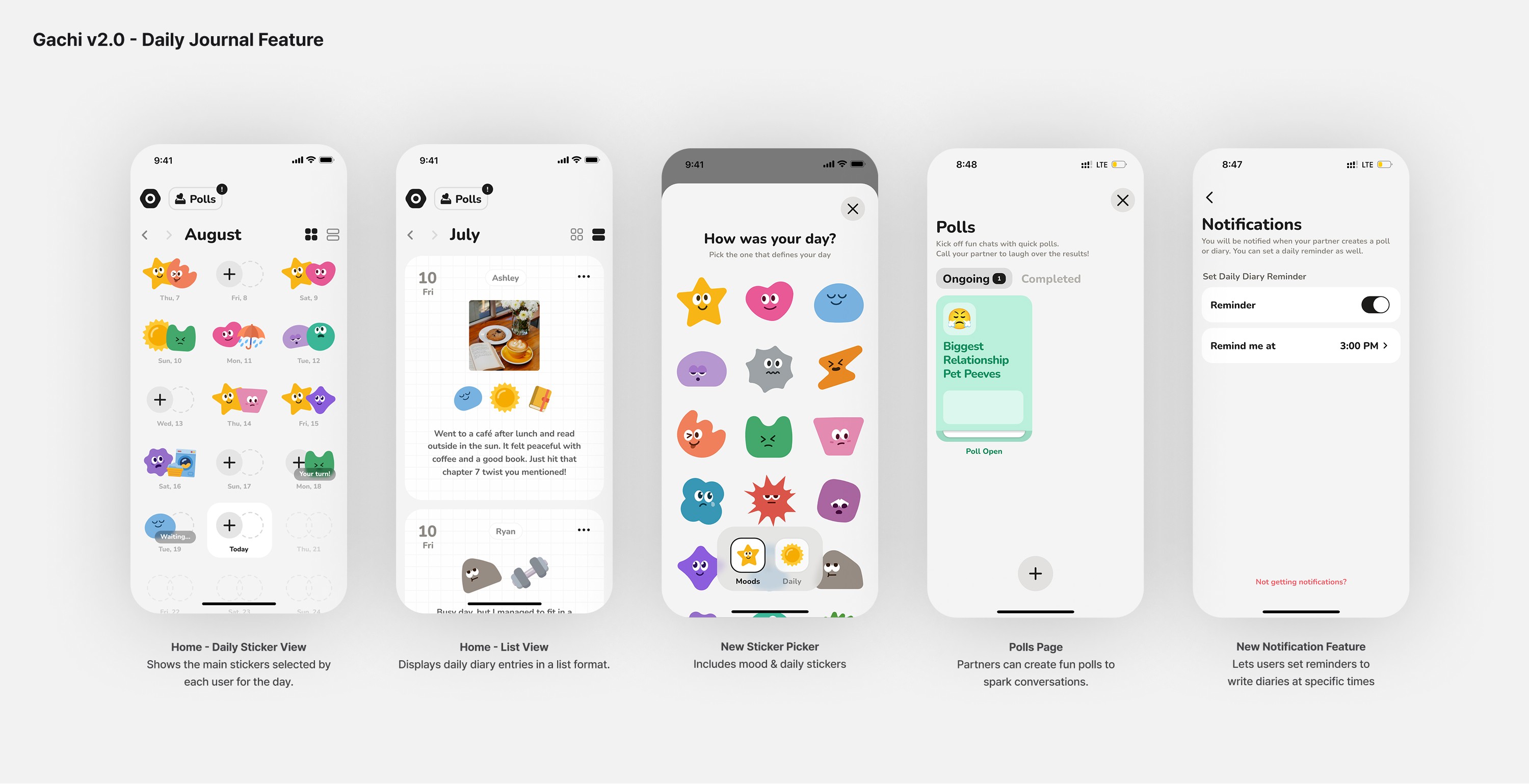
Community insights showed couples often struggle to retain and reflect on daily life and emotions. To address this, I introduced a shared journal where partners can log moods, notes, and important events.
To make journaling expressive, I designed a system of mood and daily stickers, drawing inspiration from popular mood tracker apps in Asia and my own experience noticing how differently my partner and I express moods day-to-day.Polls Repositioned
Polls were moved into a dedicated section, reframed as a lightweight engagement feature to complement the more meaningful journaling experience.
New Visual Identity
I created a refreshed sticker-based visual identity, experimenting with generative tools like Midjourney to accelerate exploration, and refining outputs into usable assets that feel consistent and approachable.Increased Database Efficiency
Supporting journaling required reworking the backend for scalability and cost efficiency. This process expanded my understanding of how architecture decisions directly influence sustainability.Growth Experiments
ASO (App Store Optimization): Reached top 100 for several target keywords (e.g. “커플 다이어리” #54 Korea, “カップル日記” #85 Japan, “Couple Journal” #28 US).
Paid Marketing: Tested Reddit, Apple Ads, and Instagram campaigns. Results showed high costs relative to conversions, so I paused experiments.
Organic Growth: Created reusable content templates for TikTok, Instagram, and YouTube Shorts to streamline production and test different formats.
Gachi has been one of the most valuable learning experiences of my career, expanding my role from designer to holistic product maker.
Key takeaways:
Cross-functional awareness
Building directly with Flutter, Flutterflow, and Firebase gave me a clearer understanding of how design decisions affect development time, backend complexity, database costs, and business goals. This experience taught me to design more responsibly and strengthened my ability to collaborate across disciplines.The power of small, intentional details
In a minimum lovable product, the little things matter. From how polls are revealed to the way stickers animate, I learned how small interactions can spark emotional engagement and make the experience memorable.
Creating a secure and cost-efficient backend
Designing for security and efficiency gave me a stronger appreciation for infrastructure design and its role in product viability.From designer to product thinker
This project sharpened my ability to balance user needs with technical feasibility, scalability, and long-term impact.
Gachi remains in its early stages. My next milestone is to reach ~100 daily active users and learn directly from consistent usage while continuing to improve stability and growth channels.